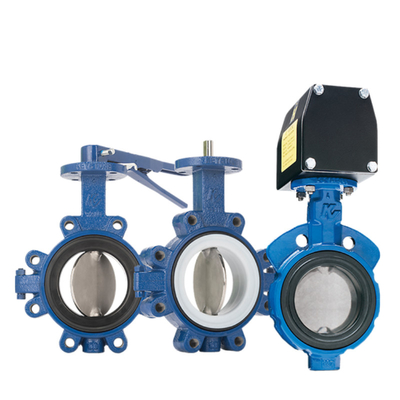
High Performance Butterfly Valve Design for Long-Term Reliability
Looking for a valve solution that combines durability, efficiency, and reliable operation?
High performance butterfly valves are widely used in chemical and petrochemical processes, particularly for equipment isolation and other on/off control applications. With a compact design and reliable shutoff performance, they can be a practical alternative to other valve types in demanding process environments.
This article looks at the key design features of high performance butterfly valves and explains how valve sealing, packing, body construction, and maintenance can affect long-term reliability.
Common Applications
Although high performance butterfly valves can be used across a wide range of operating conditions, they are particularly suitable for equipment isolation and on/off applications where bubble-tight shutoff is required.
Compared with plug valves and ball valves, butterfly valves generally require less installation space and can offer a more economical solution. However, not all butterfly valves provide the same level of sealing performance or long-term reliability. Differences in disc, seat, shaft, and packing design can have a significant impact on actual valve performance.
Sealing and Packing Design
When evaluating a high performance butterfly valve, the disc and seat design should be one of the first considerations.
Some butterfly valves achieve shutoff by pressing the disc against a soft seat and using process pressure to assist sealing. This type of design can perform well when pressure is applied from one direction, but its sealing performance may be less consistent in bidirectional service.
Other designs keep the disc in contact with the seat during opening and closing. Continuous contact can increase seat wear, eventually resulting in leakage and premature seat failure.
A more advanced design uses a double-offset configuration. During the first few degrees of rotation, the disc moves away from the seat, minimizing unnecessary contact during opening and closing. As the valve approaches the closed position, the disc returns to the seat to provide tight shutoff under system pressure.
This design helps achieve bubble-tight sealing while significantly reducing seat wear, which can contribute to a longer service life.
The use of self-adjusting sealing arrangements and durable sealing materials can further improve long-term valve performance.
Low-Emission Packing
Environmental regulations have also placed greater emphasis on fugitive emissions from valve stems. High-compression packing systems are therefore increasingly important in process applications.
Spring-loaded packing components and advanced sealing materials can maintain a more consistent compression force around the shaft. This helps control emissions while allowing smooth shaft movement and reducing unnecessary wear on the packing system.
For applications with strict emission requirements, packing design should be considered together with the valve's overall sealing structure rather than treated as a separate component.
Valve Body Design Considerations
To make installation and maintenance easier, a user-oriented high performance butterfly valve should ideally include several practical design features:
-
Standard face-to-face dimensions for easier installation and replacement.
-
Extended shaft or neck design to accommodate insulated piping where required.
-
Direct actuator mounting, allowing most compatible actuators to be installed without additional couplings or mounting brackets.
-
Optimized shaft and disc dimensions on selected designs to maximize available flow capacity.
These features can simplify installation and help reduce the additional components required around the valve.
Maintenance and Serviceability
Even high-quality high performance butterfly valves will eventually experience some degree of seat and packing wear during long-term operation.
For this reason, the seat and packing should ideally be designed for servicing or replacement without requiring removal of the shaft and disc.
Maintenance may not be required frequently, but easy access to wear components can make a significant difference when service is eventually needed. Better serviceability can reduce maintenance time, simplify spare parts replacement, and help lower the total lifecycle cost of the valve.
Key Advantages of High Performance Butterfly Valves
Compared with many other valve body designs, high performance butterfly valves can provide several advantages for equipment isolation and on/off applications:
-
Reliable shutoff performance
-
Compact and space-saving construction
-
Lower overall valve cost in many applications
-
Reduced seat wear with double-offset designs
-
Improved sealing performance
-
Options for low-emission packing
-
Simplified actuator installation and maintenance
Features such as double-offset sealing geometry, optimized disc and seat design, and advanced low-emission packing can improve valve performance while creating additional savings throughout the valve's service life.
How to Select a High Performance Butterfly Valve
When selecting a butterfly valve for an industrial project, buyers should look beyond the valve's nominal size and pressure rating. The following factors should also be considered:
-
Process medium – Check whether the valve will handle gas, liquid, steam, or other process media.
-
Pressure and temperature – Confirm that the valve, seat, packing, and sealing materials are suitable for the actual operating conditions.
-
Shutoff requirement – Determine whether bubble-tight or a specific leakage class is required.
-
Flow direction – For bidirectional service, verify that the valve's sealing design is suitable for the required pressure conditions.
-
Emission requirements – Consider packing and shaft sealing performance when fugitive emission control is important.
-
Actuator compatibility – Check the mounting interface, torque requirement, and available actuator options.
-
Maintenance requirements – Consider how easily the seat, packing, and other wear components can be inspected or replaced.
Conclusion
A high performance butterfly valve is not simply a compact alternative to other valve types. Its actual performance depends heavily on the interaction between the disc, seat, shaft, packing, and valve body design.
A well-designed double-offset structure can reduce unnecessary seat contact, improve sealing performance, and extend service life. At the same time, suitable packing, practical actuator mounting, and easy maintenance can further improve reliability and reduce lifecycle costs.
For chemical, petrochemical, power, water treatment, and other process applications, selecting the right butterfly valve design based on actual operating conditions is essential for achieving reliable long-term service.


 ข้อความของคุณจะต้องอยู่ระหว่าง 20-3,000 ตัวอักษร!